Getting found on Google is sold as a mystery, usually by someone charging a monthly fee to solve it. It is less of a mystery than that. Google publishes what decides local results, on a help page anyone can read, and the list is short. Here is that list, what the research says about each part, and what a shop, a café or a plumber can do about it this week without paying anybody.
The short answer: three things decide who shows up nearby. How well your details match the search, how close you are, and how well known you are. Distance you cannot change. The rest comes down to one profile filled in completely, the same details everywhere, real reviews, and a website behind it all.
Google publishes the rules
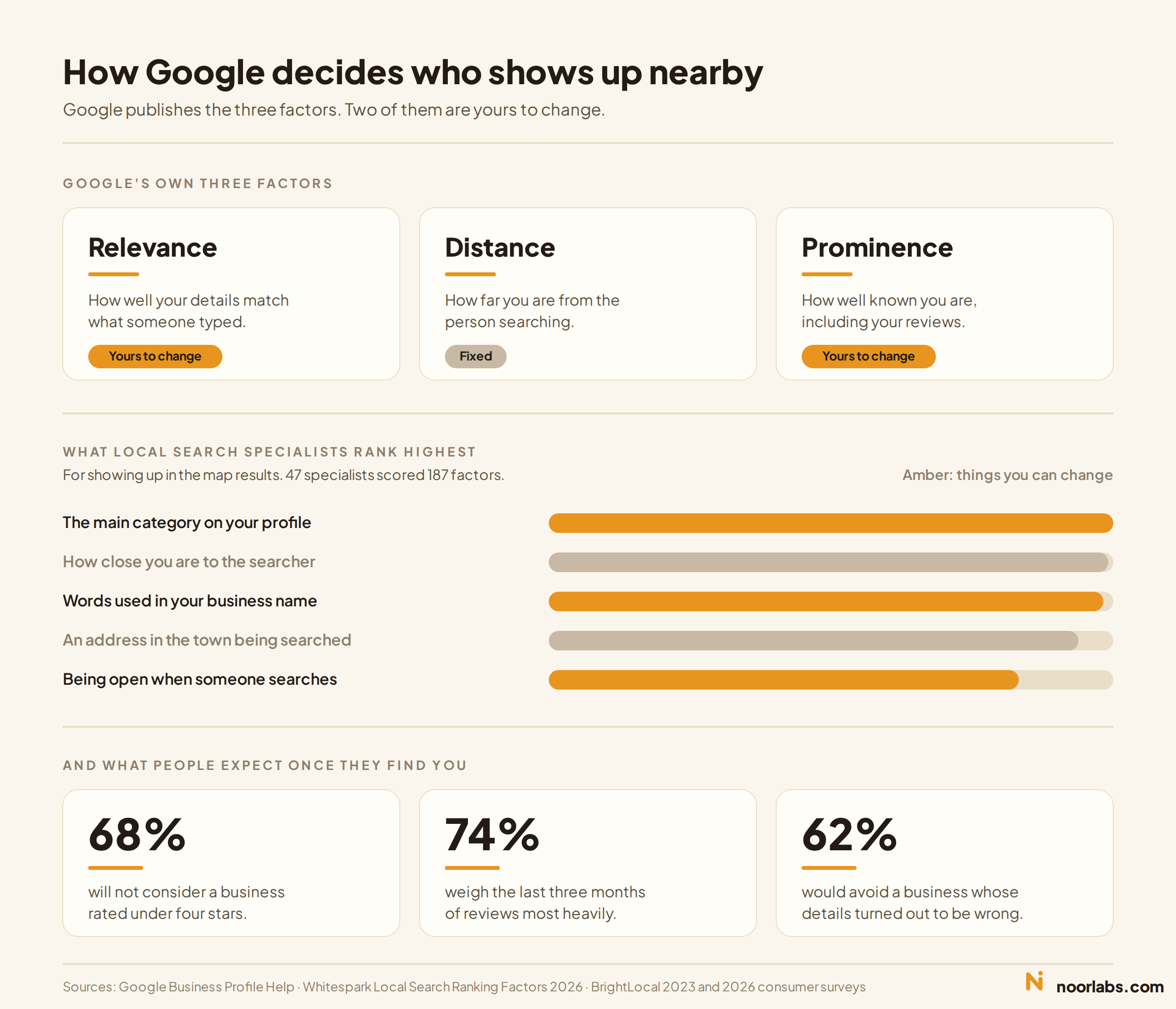
You do not have to guess at this. Google's own help page on local ranking names three factors and nothing else. Relevance, how well your details match what someone typed. Distance, how far you are from the person searching. Prominence, how well known you are, which Google says takes in your reviews and the other sites that mention you.
“There's no way to request or pay for a better local ranking on Google.”
Google Business Profile Help
Anyone who tells you otherwise is selling something. What you can do is give Google more to work with, and most local businesses have left a great deal of room there.
Where people actually look
Ofcom's Online Nation report, published December 2025, puts Google Search in front of 82% of UK adults, handling around 3 billion UK searches a month. That is the room you are trying to be seen in.
People rarely stop at one look, though. In BrightLocal's study of how consumers search, 75% used more than one channel before choosing a local business. About half started in Google Search and roughly one in ten started in Maps, then moved on to reviews, social pages and, increasingly, AI tools.
So the goal is not one perfect page. Someone spots you in Maps, reads your reviews, then opens your website to be sure. Every one of those has to say the same thing.
Start with the profile, not the site
When BrightLocal analysed 45,000 business profiles, 84% of profile views came from discovery searches rather than from people typing the business name. Those are people who did not know you existed. The profile does the introducing.
So fill it in like it matters. Whitespark's 2026 report, in which 47 local search specialists scored 187 factors, put the main category on your profile at the very top for map results. Not your website. Not how many pages you have. The category. Next came proximity, which you can do nothing about, then the words used in your business name, then having an address in the town being searched. Fifth was whether you are open at the moment someone searches.
In practice: choose the main category that describes what you mainly do, not everything you could do, and add the rest as secondary. Put in real hours and keep them right, bank holidays included. If you travel to customers rather than having a shop they walk into, set it up as a service area rather than an address.
A warning about your business name
That third factor comes with a catch. Putting your trade and your town into the business name does help you rank, and it also breaks Google's naming rules, and profiles get suspended over it. We renamed our own profile from a keyword-padded version to plain Noor Labs for exactly that reason. Use the name that is on your van, your sign and your invoices. The trade and the town belong in your categories, your services and your website.
The same details everywhere
This is the dullest part of the job and the one that quietly costs money. BrightLocal's discovery and trust research found that 62% of people would avoid a business whose details turned out to be wrong, and 56% run into wrong business details at least every few months. Asked what mattered most, people looking for a tradesperson picked correct contact details (49%). People looking for a shop or somewhere to eat picked correct opening hours (51 to 53%).
One number, one address or service area, one set of hours, matching on your profile, on your website and on any directory you are listed in. If you changed your phone number two years ago, there is probably still a version of you online handing out the old one.
Reviews are the part nobody can buy for you
Everyone knows reviews matter. What has moved is how demanding people have become. From BrightLocal's 2026 consumer survey: 68% will not consider a business rated under four stars, up from 55% the year before. 74% weigh reviews from the last three months most heavily, so a wall of five stars from three years ago counts for less than you would hope. 89% expect the owner to reply, and half are put off by replies that read like a template.
None of that needs a budget. Ask every happy customer while they are still happy, and reply to every review in your own words. It is the one ranking factor that doubles as a sales pitch.
What the website is for in all this
The website has three jobs here. It is the page your profile points at, and the Whitespark panel put the words in that page's title and headings among the things that move local rankings. It is what people open to check you are real, since 54% visit a business website after reading good reviews. And it is the only part of this you own outright. Google can suspend a profile. A social page belongs to the platform. Your site does not.
If you are still weighing up whether you need one at all, the numbers on that are in our first post.
Six things to do this week
- Claim or create your Google Business Profile if you have not already. It costs nothing.
- Set the main category to the one thing you mainly do, and move the rest to secondary.
- Check your phone number, hours, and address or service area on both the profile and your website, and make them match.
- Add photos of your own work. Not stock images.
- Ask your next five happy customers for a review, and reply to every review you already have.
- Point the profile at a page on your site that says the same thing, in the same words, as the profile.
None of that is a trick and none of it is fast. It is a few evenings of tidying that keeps paying out afterwards. What you can control is whether the answer is there when somebody looks.
Websites with the first year of hosting included.
See pricesQuestions first? The FAQ covers cost, timings and ownership, or send us a message.