We build websites for a living, so of course we would say yes. Which is exactly why this page sticks to numbers that other people collected. Government surveys, Google's own research, and independent studies, each one linked so you can check it yourself.
The short answer: yes. About a third of UK businesses still have no website, while most of their customers now start looking for local businesses online, and a growing share ask AI tools instead. A business without a website is invisible in the places where buying decisions now begin.
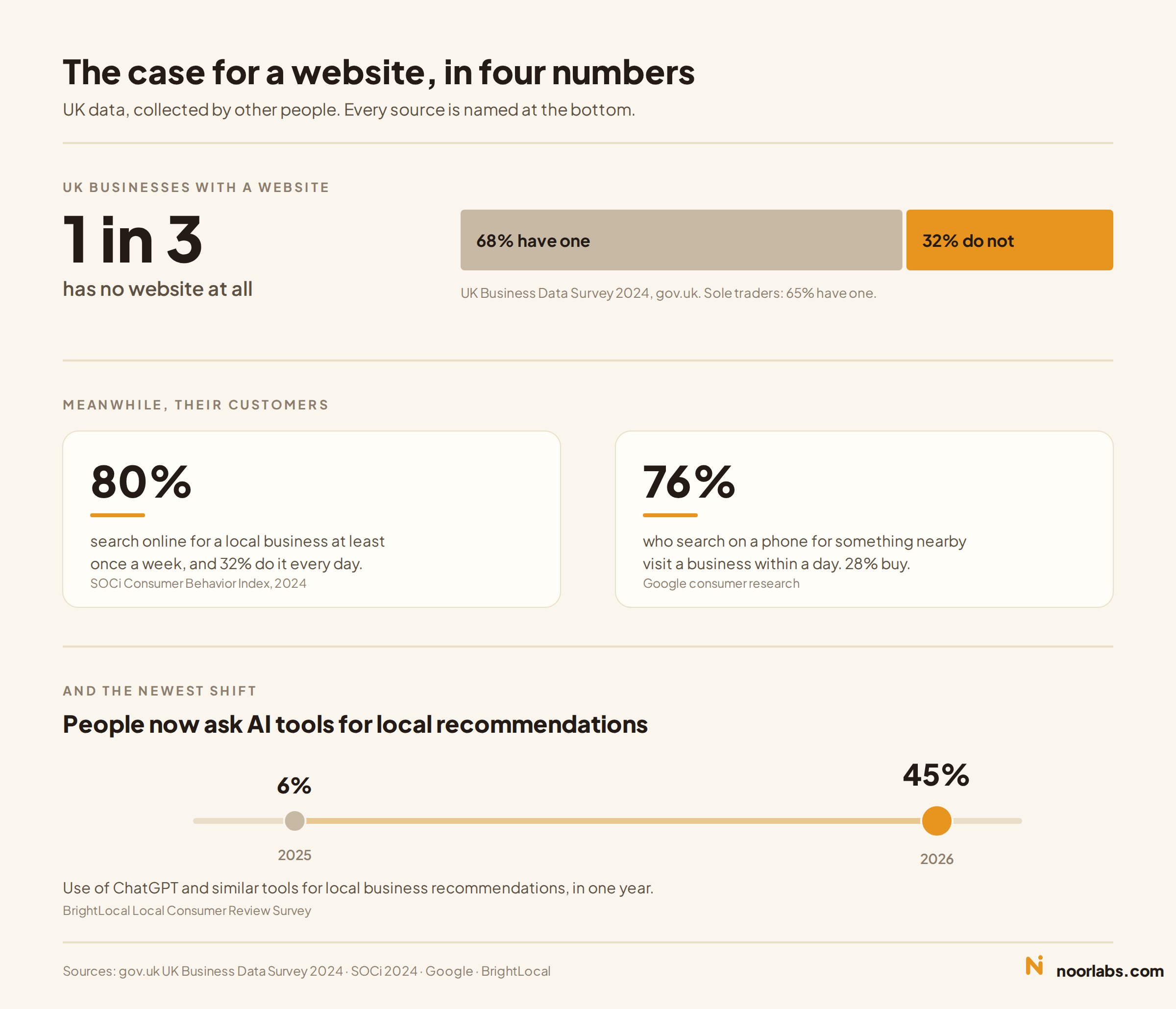
You are not alone. That is the problem.
The government's own UK Business Data Survey found that only 68% of UK businesses have a website. Among sole traders it drops to 65%. Put the other way round: roughly one in three UK businesses, and one in three sole traders, has no website at all.
Some owners read that and relax. If everyone else is offline too, where is the harm? But the more useful reading is this: in most local trades, being findable online still puts you ahead of a third of your competition. That advantage will not be available forever.
Your customers have already moved
Notice what those numbers describe. Not idle browsing, but people with a need, close by, ready to spend. Most of that looking happens on Google Search and Maps, and the businesses that show up there take the customers the rest never knew existed.
"My work comes from word of mouth"
For most local businesses this is true, and it stays true with a website. What has changed is what happens after the recommendation. Someone gives your name at the school gate or in the group chat, and the next thing the other person does is search for you. If nothing comes up, doubt creeps in. If a directory with your old phone number and the wrong hours comes up, some of those recommendations quietly die.
The research backs this up: 54% of consumers go on to check a business's website after reading positive reviews. The recommendation still does the selling. The website is simply where it lands safely, or gets lost.
"I have Facebook"
A social page is a good notice board and a poor front door. Posts sink within days. Only people who already follow you see them. The page itself belongs to the platform, not to you, and old duplicate pages with stale details have a habit of outranking the real one. We see this constantly with local shops: three versions of the same business online, each with a different phone number, and no official answer anywhere.
A website is the official answer. Your hours, your number, your prices, in one place you control, that every directory, map and search engine can defer to.
The new reason: people now ask AI
This one is recent and moving fast. 45% of consumers now use ChatGPT or similar AI tools for local business recommendations, up from just 6% the year before. When someone asks an AI assistant for a good butcher, plumber or café nearby, the assistant builds its answer from what it can read on the open web. A business with a clear, factual website can be found and recommended. A business with no website barely exists to these tools at all.
The businesses AI tools recommend are the ones whose information is easy to find: who you are, what you do, where you are, and what your customers say.
What a website actually needs to do
Not much, done well. Come up when someone searches your name or your trade nearby. Show the same number and hours everywhere. Carry your reviews, and let people reach you in one tap. That is the whole job.
That is the whole job. One extra customer a week from being findable pays for a site like that many times over, and for a shop, one new regular family doing their weekly spend with you is worth thousands a year.
Websites with the first year of hosting included.
See pricesQuestions first? The FAQ covers cost, timings and ownership, or send us a message.